Wednesday, January 9, 2019
Best Practices for Children's Choir

Best Practices for Children's Choir


Looking for ideas for your elementary or middle school choir? In this podcast episode, I'm talking with my friend and colleague Matthew Parker about best practices for children's choir!

Best practices for children's choir: Podcast and blog post with ideas for warm-ups, octavos, social events for choir, and more!


Listen to the podcast here:


Matthew Parker received his master of music in music education with an emphasis on Kodaly From capital University. He currently teaches at Johnnycake Corners Elementary school in the Olentangy Local School District in Central Ohio. Matthew was voted as Teacher of the Year during the 2008-2009 school year. Matthew was also selected as the Columbus Symphony Elementary Music Educator of the year in 2015. During the 2012-2013 academic year, Matthew worked with, and hosted, the Emmy nominated Carpe Diem string quartet to bring an online, interactive concert series to students in several states across the nation. Matthew was a director on staff with the Columbus Children’s Choir, and has two elementary choirs at his school. As a composer, one of the songs was prepared by the Columbus Children’s Choir. As a performer, Matthew has performed with the Capital University Chapel Choir, Columbus Symphony Chorus, and the Lancaster Chorale.

In this podcast, Matthew discusses everything from choosing music to warm-ups. Here are specific notes with his suggestions:

Matt conceptualizes his choir as having three aspects:
  • Performance: Formal performance opportunities, such as evening concerts
  • Community: Community performance opportunities, such as performing at a community center, caroling, etc.
  • Social events: Such as a pancake breakfast or movie night for choir students
Thinking of best practices for choosing music? Here is Matt's formula for choosing repertoire:
  • Well-written text: purposefully and authentically written
  • Excellent piano accompaniment: Make sure it's not in an odd key, not written by non-pianist. Can try out several with your piano accompanist to help decide your final repertoire.
  • Extractable phrases
  • Have to love it!
Here are Matt's favorite octavos:
Rounds can be a great way to improve partwork skills and add to a concert program. Here are Matt's favorite rounds:
  • Frere Jacques
  • Laugh, ha, ha
  • The Ghost of Tom/ John
  • Dona Nobis Pacem
As you are choosing music, here are arrangers and composers whose music Matt and I love:
  • Ruth Dwyer
  • Andy Beck
  • Susan Brumfield
  • Doreen Rao
When warming up your choir, try these warm-ups:
  • sfmrd on "ooo"
  • Follow the leader:
    • Students follow the hand signs step-wise
    • Students follow the teacher with hand signs, then teacher pauses and students pause with teacher
    • Students follow the teacher with hand signs, and the teacher moves up and down 
    • Split the choir into two groups: group 1 follows one hand sign, group 2 follows the other hand sign
As you're planning for choir, here are favorite resources from Matt and I:
I hope you have found this helpful as you plan for your children's choir rehearsals. A huge thank you to Matt for his expertise and willingness to share!
Wednesday, December 12, 2018
Renewal and rejuvenation over winter break

Renewal and rejuvenation over winter break


Looking ideas for rejuvenating over winter break? In this podcast episode, Emily Karst and I talk about renewing and rejuvenating over winter break.

Rejuvenation and renewal over winter break: Ideas for music teachers


Listen to the podcast here:


Links mentioned in the podcast:

Wednesday, November 28, 2018
Christmas and other winter holidays in the music room

Christmas and other winter holidays in the music room


Looking for fun activities during the winter holiday season? In this podcast episode, I discuss my favorite ways to celebrate Christmas, Hanukkah, and Kwanzaa in the music room!

Winter Holidays in the Music Room: Picture books, movement ideas, performance pieces, and more for your music lessons!
Listen here:


Links mentioned in the podcast episode:


Games:
Picture books:


Sleigh Ride Cup Routine:


Choir songs:

What I'm consuming: "Meditation Now"
Wednesday, November 7, 2018
Learning Styles in the Music Room

Learning Styles in the Music Room


Looking for strategies to address physical, visual, and aural learning styles? In this podcast episode,  Katie and I discuss learning styles, strategies, and more!

Learning Styles in the Music Room: Strategies for addressing physical, visual, and aural learning styles in the music room, to practice rhythm and melody!


Listen to the podcast here:


Links mentioned in the podcast:

Saturday, November 3, 2018
Differentiation in the Music Classroom

Differentiation in the Music Classroom


The term "differentiation" has been used more and more often in education lately. What does it mean? How does it apply to the music room?

Differentiation in the music room: Lesson plan strategies for differentiating for your music lessons!


According to Carol Ann Tomlinson--an expert on differentiation-- differentiated instruction is defined as factoring students’ individual learning styles and levels of readiness first before designing a lesson plan (from this blog post from Concordia University- Portland.) So what does this look like in the music classroom?

I've heard many music teachers say that differentiation happens naturally in the music room. I agree...to a degree. There IS a lot of differentiation that happens organically in music, but there are also differentiation strategies that we can employ with thought and intention. Here are my favorite ways to differentiate:

Include lots of variety
By including lots of variety in your lessons, including activities that cover the gamut of Bloom's Taxonomy, you can help address each student's ability. For example, in one lesson, you could ask students what these rhythms are called (i.e. ta and ti-ti, which would be remembering), you could have students apply their knowledge of rhythms by playing rhythm patterns on non-pitched percussion, and you could have students create using ta and ti-ti. This variety would not only lead to an active, engaging lesson, but would allow students opportunities to showcase their knowledge at their ability level.

Plan for extensions and simplifications
Let's say you've given your students the chance to figure out how to play "Bounce High" on barred instruments, with G as sol. If a child is able to figure it out sooner than other students, you could have them figure it out with C' as sol, or A as sol (if you add a F# bar.)

If a student is struggling with figuring it out, you might write in the note letters for them, or give them a simpler song without la, such as "See Saw."

Have students self-differentiate
If you've given students a few tasks at different levels (different ostinati, for example) you could have students choose which one they'd like to do. If one of the ostinati is simpler than the others and one is more difficult, this can be a great way for students to perform at their ability level and feel comfortable.

This could work with Orff arrangements, as well. After teaching a more difficult part, I've sometimes looked for students who could perform the body percussion to assign that part, and I've also simply asked students who wanted to try it. Students who are ready for the challenge will volunteer, and those who are not quite ready likely won't.

Differentiate during centers
This has been new for me this year. I've created at least two centers during centers lessons that are differentiated. At these centers, students complete the task for the color they've been given. I've taken pre-test data, and have sorted students into three groups (level 1/ basic= blue, level 2/ proficient= green, and level 3/ advanced= pink.) Before students start doing centers, I hand them a slip of paper with their color, so they know which task to complete at those centers.

One example of this is rhythm flashcards. At this center, students play patterns on non-pitched percussion. The blue flashcards at that center have simpler patterns, the green flashcards have middle-of-the-road patterns, and the pink flashcards have more challenging patterns. If a student has been given a green slip of paper, they play the green flashcards. I've also combined this idea with having students choose their own centers, like in this blog post, where students can float from center to center and change whenever they want, but at the centers with differentiation, they do that color task.

Looking for more ideas for differentiation with centers? Check out this bundle; individual sets can be bought separately.


Also, check out this post by Debbie from Crescendo Music with more differentiation strategies.

What's your favorite way to differentiate in the music room? Feel free to comment below, and happy teaching!


Wednesday, October 24, 2018
Giving students input for musical programs

Giving students input for musical programs


Looking for ways to give students input for musical programs? In this podcast episode, I discuss a process I used for giving my fifth graders input for their recent musical program, based on the book "To Be a Drum," by Evelyn Coleman and Aminah Brenda Lynn Robinson.

Giving students input for musical programs: Ideas for giving students ownership for their performance!


Listen to the podcast here:


Wednesday, October 10, 2018
STEAM in the Music Classroom

STEAM in the Music Classroom


Looking for ways to integrate STEM or STEAM into your music room? In this podcast episode, I talked with my friend and colleague Emily Anderson Karst about ideas for STEAM, coding, and more!

STEM and STEAM in the music room: Lesson ideas, activities for coding, and more!


Listen to the podcast here:


Free resources:

Links mentioned:


What we're consuming:

Follow Emily:

Wednesday, October 3, 2018
Giving students choice during centers

Giving students choice during centers


I've been using centers for several years now, and have really enjoyed the student-centered learning environment and the chance to work with students one-on-one. In today's post, I'm writing about something new I've been trying: giving students choice during centers!

Giving students choice during centers: Ideas for allowing students to choose their centers in music class


So why give students choice during centers? In my experience, students really love the ability to choose what they do, when. In fact, just this week, after I told the students they get to choose, I had a student look at me incredulously and exclaim, "We get to choose?!?! That's COOL!"

So how does it work?
Typically, when I do centers and am not having students choose, I have 4 centers spread out around the room, and I tell them who's in their group, and when they switch (usually every 5 or so minutes.) Because students get to choose in this scenario, I use 6 centers, so there's more from which to choose. I spread out those 6 centers around the room, explain each center, then tell students they can go to whichever center they want, and can switch whenever they want.

Are there rules?
Yes! I tell students that they have to go to at least 3 of the centers. About halfway through the class, I'll play the wind chimes (so students know to get quiet) and remind students that if they have only visited one center, they need to rotate soon.

This week, I have one center that I'm asking all students to visit--a worksheet center--because I'm using the worksheet as an assessment. Students have to monitor themselves and make sure they visit (and I remind them throughout the lesson.)

If I notice that a student is not on task at a center--especially after a reminder--then I tell that student that he/she is done with that center and has to visit another. I sometimes also tell students who are not making good choices together that they have to separate.

I let kids know ahead of time that if there are lots of kids at one center, they should go to another center until it thins out a bit, especially if there are not enough materials at that center.

Looking for an example?
Here are six centers you could use to practice ta and ti-ti, with students choosing their center.

Center #1: Students finish the ta and ti-ti dabbing worksheet in this freebie, using dabbing markers.

Center #2: Students throw a squishy ball at the SMART board and read the patterns, like in this game.

Center #3: Students compose patterns with this "We are dancing" freebie.

Center #4: Students use popsicle sticks like in this blog post and dictate rhythms for known songs/chants or compose rhythm patterns.

Center #5: Students play Boom Cards for ta and ti-ti on iPads or Chromebooks

Center #6: Students play this Slug Bug game by Amy Abbott, with fly swatters (using only the ta and ti-ti cards from the set)

Looking for more centers ideas? Check out this bundle; you can also purchase the sets separately:


I hope this helps as you try something new in. your music room, and that your students enjoy it as much as mine do! Happy teaching!
Thursday, September 27, 2018
See the old witch {A Halloween music composition activity}

See the old witch {A Halloween music composition activity}


Looking for a fun Halloween activity that gets students composing and practicing quarter rest? In this blog post, I'm writing with a favorite activity for students during the Halloween season...or any time!

Composing with "See the old witch": Blog post includes a freebie for having students compose during Halloween, or any time of the year!


"See the old witch" is a fun singing game that my first graders really enjoy. Here's the notation:


For the game, students sit in a circle, sitting down. One child is chosen to be “it” and has a penny in his/her hand. All other students close their eyes and put their hands behind their back. As they sing, the person who is “it” walks around the circle. At the end of the song, he/she drops the penny into the hands of whoever they are closest to. That child opens his/her eyes and chases “it” back to that child’s spot! The game continues with the chaser being “it.”

After students are comfortable with the song, I print out cards like the ones shown below onto cardstock, and have students as a whole group choose which cards go where (you can use magnetic tape like this to stick to your white board). We chant this as a B section--repeating it after saying it once, with the song being the A section. So if we were to perform ABA form, we'd sing the song, chant the B section, then sing the song again, like this:

Sung:
See the old witch/ Fell in a ditch/ Found a penny and/ Thought she was rich.
Spoken:
Found a penny/ Witch/ Found a penny/ Fell down!
Sung:
See the old witch/ Fell in a ditch/ Found a penny and/ Thought she was rich.

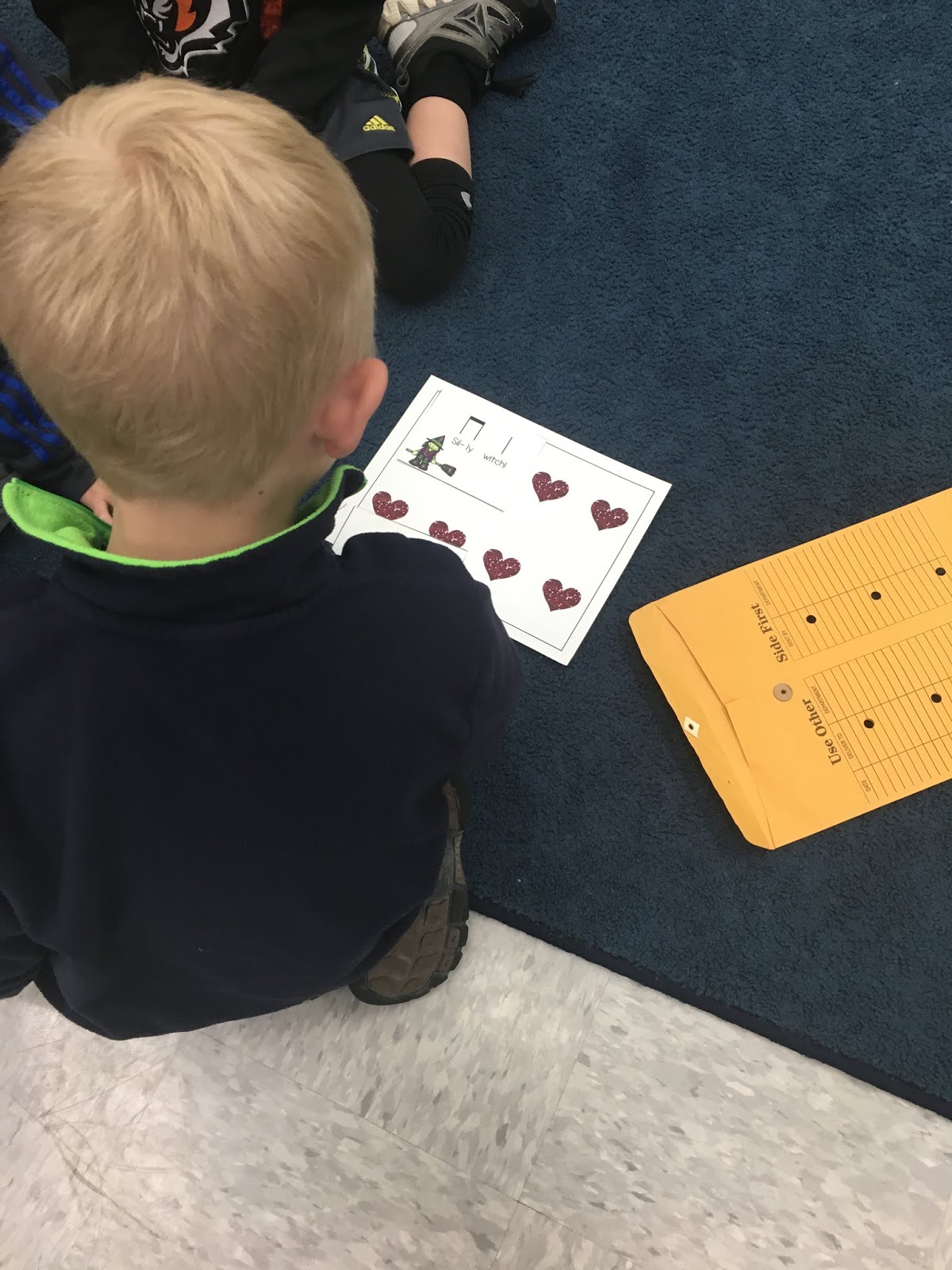
In the next lesson, you could show the students the cards again and work with them as a full group, but then we split up into small groups and students get a chance to compose in small groups, getting 2 copies of each pattern. I give students 5-10 minutes to work with their groups, to choose 4 cards and place them on top of the beats, then read the cards with the group, adding a repeat sign at the end, so that they chant twice. I ask them to use at least one "witch" card, and tell them they can repeat a pattern. Here's a picture of one of my students working with the cards.

Composing with "See the old witch": Blog post includes a freebie for having students compose during Halloween, or any time of the year!

Students could perform their compositions in a rondo, with the song being the A section, and each group's composition being the alternate sections (A= we all sing, B= group 1 performs, A= we sing, C= group 2 performs, etc.) As students are performing, I find it helpful to play the steady beat on a hand drum or tubano. (Beware: many students will want to skip over the rest, so it's a great way to practice!)

Interested in using these cards? Download them for free HERE.

Looking for more Halloween activities? Check out this set, which could be used as sub plans, or as lesson plans during October.


Happy teaching!


latest videos

ON YOUTUBE