Friday, September 12, 2014
Five Teaching Tips for Music Centers

Five Teaching Tips for Music Centers


Even though I've been doing centers for a few years, I am still learning how most effectively to run a centers lesson in my music room. I've written a few blog posts about centers, which you can read here, but thought I'd offer five tips for doing centers in your music classroom.

5 teaching tips for music centers: Includes great suggestions for your music lessons!


#1: Think about noise
This week, I've been using materials from my fourth grade centers set, shown below:


Two of the centers--the solfa manipulatives center and the instruments center--depend on students being able to hear. Here are a couple pictures of these centers:
5 teaching tips for music centers: Includes great suggestions for your music lessons!

5 teaching tips for music centers: Includes great suggestions for your music lessons!

I knew they both involved being able to hear...but then I planned them to be next each other.
I know, I know, it's silly that I would do that! But planning was tight and I was distracted and I just wasn't thinking. About one minute into the first center, as I sat at the solfa manipulatives center assessing students, I realized my mistake! 
I did a couple things to help. First, I had my students at the instruments flip their mallets around into what I call "practice mode." Then, during the next lesson, I moved the solfa manipulatives center. Students could hear so much better! Consider the amount of concentration students will have to have, and how noise will affect that. Spread centers out if possible, or just plan one center involving noise.

#2: Anchor yourself strategically
While I was at the solfa manipulatives center assessing students (now sitting a ways away from the instrument center), I realized that my students, although overall very well-behaved, were taking the math counting chips I had them using for staff work and flicking them at each other. Luckily, I was anchored close by so I could watch and give warnings as possible. Here is a picture of the staff center with those fun little chips:

5 teaching tips for music centers: Includes great suggestions for your music lessons!

Students will try to take advantage of the freer environment...so just make sure you are near anything that might be a problem!

#3: Only have one high-maintenance center
As I sat at the solfa manipulatives center, I realized how much I appreciated having a student teacher, as she was able to work with the students at instruments, trying to transfer their knowledge of solfa to the barred instruments and figure out the song "Tideo," knowing that mi is E. 
She was so excited to see them transfer their knowledge--but she did have to guide some students more than others. Had I  done a similar activity in a previous lesson, those students would maybe not have needed as much assistance, but I didn't...so I'm glad she was there! 
If you are anchored at one center, assessing students, think about how much students can work independently at the other centers.
Here is Mason, figuring out how to play "Tideo." I had a few students who easily figured it out (including my own daughter) which was very exciting!


#4: Think about how students will be grouped
Sometimes, when I group students for centers, I do it randomly. Other times, I look at their previous assessments and pair students by skill (with struggling students working with students who understand the material well.) The first time I did centers this week, I just had students grouped by last name (first 5 alphabetically at one center, second 5 at next center, etc.) but then some kids were disappointed (as they were the only girl in the group or the only boy in the group.) I tried something different in a later class, and then had students choose their own groups, with no more than 5 at one center (as I had 5 centers.) That seemed to work well, although there were a couple kids I had to watch closely. :) Think about how you want to group the students beforehand. If you want to provide intervention to specific students, then you will want to figure out the groups beforehand.

#5: Give you and your students enough time
Now that I have 50 minute classes, I decided to do 5 centers, and to lengthen the time to 6-7 minutes. Since I was anchored at one center, I decided to just let each rotation go until I was done assessing each group and had walked around a bit to check on all of the other centers. I loved having a longer class period so we didn't feel rushed! Think about how many centers you want, how much time you have, if you will be assessing, and if students will have too much or too little to do.

I hope this has been helpful! What are your tips for centers? Feel free to comment below!


Thursday, August 21, 2014
Thoughtful Discussions in Music Class

Thoughtful Discussions in Music Class


This past summer, I was fortunate enough to take a class through my district about making thinking visible. We use the word "think" a lot, but it wasn't until this class that I really thought about what thinking means! While I'm not an expert in the area of making thinking visible, I'm going to write about a discussion I had with my first and second graders that I found very insightful.

Thoughtful discussions in music class: Getting students thinking about musical concepts, like steady beat!


When I took this course, I read the book "Making Thinking Visible." The book can be viewed on Amazon by clicking on the picture below. It is a wonderful read!

While I read many of the routines and strategies in the book, I was both excited by the possibilities and worried about how I would find the time to have meaningful discussions. So many music teachers try to fill the time we have with our students with engaging activities, with singing, playing, dancing, etc., and we STILL don't feel like we have time for everything we need to teach! How would I have these conversations with these students and still have time for what I needed to teach?

Well, part of the answer is that through these conversations, students will learn more, and the other part of the answer came in the form of a new schedule for me this year. The number of times I see students is a bit confusing to explain, but I do see the students in grades 1-5 for fifty minutes instead of thirty-five. At first, I wondered how I would fill the extra time (More activities? More instrument playing? More dancing?), and I also worried it would feel really long, but honestly, I like it much better than I thought I would. I don't feel so frantic when I teach...AND I have time for these conversations the books recommend!

I decided to be brave and try a simple thinking routine on the first lesson. Crazy, I know! But after we learned the rules and procedures and played a couple games (and after we finished a beat-keeping activity), I asked my first graders, "What do we know about beat?"

It was kind of scary, to be honest. I've never seen another music teacher try to carry this kind of conversation. What if they didn't answer? What if they didn't answer correctly? Well, to my delight, here were some of their responses (all of which I wrote down on the SMART board so I could refer back to them):

  • The beat stays the same.
  • The beat goes over and over.
  • The beat keeps going.
  • When the music stops, the beat stops.
  • You can change the beat.
  • The beat is different than the rhythm.
  • The beat is steady.
  • It's like the heartbeat.
  • We do motions with the beat.
  • We can hear the beat.
  • We can follow someone else's beat.
  • We can keep the beat on our laps.
  • We can keep the beat in our feet.
  • We can keep the beat anywhere.
This, to me, told me they understood beat at not just a surface level. I know their thinking can get even deeper, but I was excited with this to start!

If you're interested in having a conversation like this with your students, here are some suggestions:
  • Word the question so that it is not too specific. You want some "big ideas" to come out of the question, so if you ask a question that can be answered with "yes" or "no" then those big ideas might not evolve out of the discussion. I had the question "What is the purpose of beat?" from my Essential Questions set on the board, like this, to help guide the discussion further:
  • Wait. I had a few conversations in which it was like listening to crickets at first. NO ONE raised their hands for a while (especially when I had a similar conversation with my fifth graders about rhythm!) Then I would repeat the question, elaborate a bit more, and a brave soul would raise his/her hand. After that, others followed suit. I think it'll be this way for a while, until they are used to these kinds of conversations in the music room!
  • Adapt your instruction if needed. If students don't answer the question in a way that shows understanding, then circle around back to that concept in your instruction.
  • Read the book! I can't do it justice with one blog post, or even several blog posts. The book is wonderful, full of tons of different routines that could work well in the music room, and well worth the read!
Good luck with your discussions, and have a great weekend!

Tuesday, August 5, 2014
My Music Room Set-Up`

My Music Room Set-Up`


Today I am very excited to blog about my music room set-up for this year! (Thanks to Dancing Crayon Designs, KG fonts, and Sassy Designs for the cute fonts and graphics!)


So this year, since our school-wide theme is "Out of this world," I decided to do a space-themed classroom. After making that decision, I got to work and created a space-themed music classroom set, which you can view by clicking on the picture below:


I found a seller on Etsy that makes really cute out-of-the-world signs. Here is my sign I will be posting outside my room:

Cute space-themed sign for your classroom! Blog post includes tons of other ideas for your space-themed classroom!
Isn't it cute?? You can order one for yourself (with several different designs, with your own name) by clicking on the picture above.

Here are a couple shots of my room:

My Music Room Set-Up: Blog post with TONS of ideas for organization and decor in your music and/or space-themed classroom!


My Music Room Set-Up: Blog post with TONS of ideas for organization and decor in your music and/or space-themed classroom!


Here are my bookshelves. I used the editable word wall template in my set to create labels for my bookshelves. It is the only way I can stay organized (and as you can see, I still have some organizing to do!)


Here is my counter. I bought the black baskets at Wal-Mart, and the plastic bins at Staples. The plastic bins are for organizing my melodic and rhythmic materials. I'm going to buy another one soon to organize all of my centers materials!


I found this magnetic board in Gatlinburg on our vacation, in a gift shop. The animals are magnets by a company called Natural Life (not space-themed but cute nonetheless), but you could use whatever magnets you want. I plan on hanging student work and notes so I can enjoy them!

Here are my music rules, which are included in the set.

Here is my space-themed musical symbol set (which is similar to my chalkboard musical symbol set); the set shown below is also included in the classroom decor set. 
My Music Room Set-Up: Blog post with TONS of ideas for organization and decor in your music and/or space-themed classroom!

Here is my word wall, also included in the classroom decor set. It took a while to cut and laminate but I love the way it looks!
My Music Room Set-Up: Blog post with TONS of ideas for organization and decor in your music and/or space-themed classroom!

I wrote about using colored bins in this blog post; here is one of my bins. The other three are spread throughout the room; hopefully having them far away from each other will help kids get their materials quickly and smoothly!

In my last blog post, I wrote about this awesome bulletin board set by David Row at Make Moments Matter. I love that it showcases I can statements AND is space-themed. Also, thanks to Lindsay Jervis for the idea of layering bulletin board trimmer. Love it!
My Music Room Set-Up: Blog post with TONS of ideas for organization and decor in your music and/or space-themed classroom!

I just created this bulletin board set, and have added it to my space-themed set. If you've already purchased it, you can simply re-download under "my purchases" for the new sets.
My Music Room Set-Up: Blog post with TONS of ideas for organization and decor in your music and/or space-themed classroom!
The idea of this set is to first work on the lines of the treble clef. The posters say "We're flying fine...when we are on the lines!" and the flying saucers have the letters of each line (E, G, B, D, and F.) I used monster duck/ duct tape which I found at OfficeMax (looks like aliens!) and made the treble clef out of silver duck/ duct tape. I have black fabric as the background, which made it a bit easier when working with the tape. When I move to spaces on the treble clef staff, I'll change the visuals to say "In space..we say FACE!" and the flying saucers will change to F, A, C, and E.

Here is my last bulletin board. It is out in the hallway; students can post their names there after receiving star student at the end of class (if they get that reward on my SMART board.) I'll keep adding to this board as more star students add their names! I have added the visuals for this to my "Out of this world" set.

Star student bulletin board: Cute way to keep track of who has been star student!

When I decided to do a space-themed classroom, I found this blog post about creating a solar system with paper lanterns. I thought it was so cute that I had to buy some paper lanterns for myself!  I also found a cute black chair and alien pillow (from Wal-Mart); here they are below.
My Music Room Set-Up: Blog post with TONS of ideas for organization and decor in your music and/or space-themed classroom!

I found out that I probably can't hang paper lanterns from the ceiling because of fire code, so I hung them off the wall like shown below. I used fishing line, tied one end to a pushpin, pushed that into the square above my white board, and then tied the other end to the paper lantern. The first lantern is supposed to be the sun, so I am missing a planet (and I want to add a ring to Saturn) but I still love the way it looks!

My Music Room Set-Up: Blog post with TONS of ideas for organization and decor in your music and/or space-themed classroom!

That's pretty much it! Make sure to click below to see the other music room set-ups of other music teachers!


Tuesday, July 29, 2014
Bulletin Board Ideas

Bulletin Board Ideas


Today I'm excited to link up with David Row from Make Moments Matter, for his Back to School Bulletin Board Ideas in the Music Classroom Linky Party!

I'm going to post some of my past bulletin boards. Here goes!

Bulletin board ideas for the music room: Great ideas for your music classroom!

#1: Music around the world
Bulletin board ideas for the music room: Great ideas for your music classroom!
I used this bulletin board to post any songs we learned from around the world. For example, when we learned "Ye Toop Doram" from Afghanistan, I posted a slip of paper with the title of the song, with yarn tied to a pushpin, which was pointing to Afghanistan. When learning songs from the United States, I figured out exactly which state the song was from and labeled it here. This is a great visual for geography, and for giving context to multicultural songs!
#2: Wild about composers
Bulletin board ideas for the music room: Great ideas for your music classroom!

I used this bulletin board to post any composers that were currently being studied. For example, if my second graders were using "Rondo Alla Turka" to practice sixteenth notes, I could post Mozart, like shown above, and if my first graders were studying Beethoven for "Symphony No. 7," movement 2, to practice quarter rest, I could add his picture as well.

#3: Musicians from Ohio (or from any state!)
Bulletin board ideas for the music room: Great ideas for your music classroom!
A couple years ago, my school did a "Wild about Ohio" theme, so I did some research and found out which musicians came from Ohio, then created this bulletin board. You could do this for any state or province, though! To create the map of Ohio, I simply projected a map on a wall, taped some paper on the wall, and traced. I used pushpins to show the musicians and from which city they came.

#4: Black History Month
Bulletin board ideas for the music room: Great ideas for your music classroom!
The visuals from this set are from my "Songs and Activities for Black History Month." In the future, I think I'll post this on lighter paper so the visuals pop more, but still, this is a fun way to teach about legendary musicians during Black History Month!

#5: First Fingerings
Bulletin board ideas for the music room: Great ideas for your music classroom!
I used my fingerings sets for the instruments I was teaching last year to post this set. It was a nice way to review the first fingerings for each instrument!
If you are looking for other bulletin board ideas, make sure to check out David's post by clicking on the linky party image below.


Looking for more music bulletin board ideas? Check out these!

Have fun creating and posting bulletin boards, and have a great week!
Tuesday, July 22, 2014
10 Strategies for Melodic Reading and Writing

10 Strategies for Melodic Reading and Writing

10 strategies for melodic reading and writing: Great ideas for your music classroom to extend learning of melody and solfa!

A few days ago, I wrote about 10 strategies for rhythmic reading and writing, in hopes of giving you ideas for your year plan. Today I will blog about 10 strategies for melodic reading and writing! As in the last blog post, some of the ideas I will describe in this blog post, some will link to other blog posts, and some will link to freebies and other products. Here goes!

10 strategies for melodic reading and writing: Great ideas for your music classroom to extend learning of melody and solfa!


#1: Ghost Melodies
Ghost melodies: A great idea for having students compose vocal exploration patterns! Blog post includes other great ideas for melodic reading and writing!
In this blog post, I wrote about how to do ghost melody composition on dry erase boards. This is a great precursor to having students listen for and begin writing specific pitches, like sol and mi.

#2: Staff writing
10 strategies for melodic reading and writing: Great ideas for your music classroom to extend learning of melody and solfa!
In this blog post, I wrote about how to introduce the staff to first graders. You could use chips (math counting chips work well because they are see-through, and students can see the line running through the note) or you could use cute seasonal erasers like I did in the blog post.

#3: Whole group stick to staff
Once students can sing from stick notation patterns (with only rhythm and solfa written underneath the rhythm) and staff notation patterns, they can begin to see the connection between the two. Here is a freebie I posted for help with transferring stick to staff for sol-mi (just click the picture to be taken to the download!)


#4: Small group stick to staff
10 strategies for melodic reading and writing: Great ideas for your music classroom to extend learning of melody and solfa!
Once students have worked as a whole group transferring stick notation to the staff, they can work in small groups to do the same. The above picture was taken while students were working with my Penguin Stick-to-Staff set for low sol; students had to work with the small group to match up the stick notation patterns with the corresonding staff notation patterns. It was so cool to hear their conversations about why cards matched or didn't match!

#5: Dulcimers
Playing dulcimers in the elementary classroom: Ideas for using them to extend melodic learning. Blog post includes lots of other great ideas for melodic reading and writing in the music classroom!
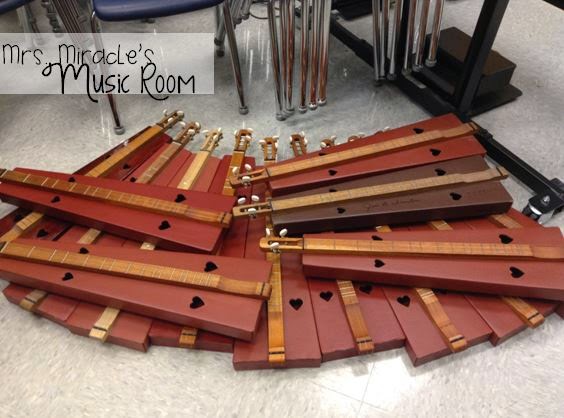
Playing dulcimer can be a great way for students to transfer their knowledge of solfa to an instrument! You could put the staff notation or stick notation for "Hot Cross Buns," for example, on the board, show them where do is, and see if they can figure out how to play it on their dulcimers! My students are using cardboard dulcimers in this picture; you can purchase them here, and see my set below.
Playing dulcimers in the elementary classroom: Ideas for using them to extend melodic learning. Blog post includes lots of other great ideas for melodic reading and writing in the music classroom!


#6: Recorder tic-tac-toe
Speaking of instrument playing, I love this game by Amy Abbott from Music a la Abbott! Students can play in teams, see the staff pattern, play it on their recorders, and try to collect points! The interactivity of the powerpoint is really cool--after they play the pattern, you can click X or O, and watch it appear on the tic-tac-toe grid. Anytime you can make a game out of building a skill is a great opportunity for improving their learning! Click the picture to see the product.

#7: Sight reading
To have students sight read a melody, you could just have them try singing through it...but unless they have lots of experience, it might fall apart! I often go through this process for sight reading, whether from stick notation or from the staff:

  • Read the rhythm with syllables
  • Speak the solfa (I have heard that some people think that solfa should never be spoken, but speaking from experience, this is a good way to get students to understand how the solfa fits with the rhythm!)
  • Inner sing the melody: Give students a starting pitch and have them do the hand signs, singing inside their heads 
  • Sing the melody aloud
Going through this process really seems to help break down the sight-reading into manageable steps and helps them be successful!


#8: Solfa manipulatives
10 strategies for melodic reading and writing: Great ideas for your music classroom to extend learning of melody and solfa!
In this blog post, I wrote about using solfa manipulatives with my students. I LOVE to use these as a precursor to writing or reading on the staff, and to really target their inner hearing. They also work really well as an assessment during whole group or centers!

#9: Hand staff
Having students use their hands as a staff is a very helpful way for them to kinesthetically understand lines and spaces on the staff. To use the hand staff, I have students look at the inside of their hands, and point to their pinkies for the first line, ring finger for the second line, etc. The first space can be between their pinky and ring finger. You could have them sing solfa while pointing to the correct spots on their hand staff. You could also do the hand staff incorrectly and see if they can figure out the mistakes!

#10: Poison Patterns for Preparation and Practice


I just posted this fun set for playing melodic poison during preparation AND practice. Poison is one of my students' favorite games, and with this set you can project on your SMART board, white board, or print out the cards. Click on the picture to see the product.

Which strategies do you like for melodic reading and writing? Comment below, and happy teaching!

Friday, July 18, 2014
10 Strategies for Rhythmic Reading and Writing

10 Strategies for Rhythmic Reading and Writing


With this blog post, I'm hoping to give you lots of ideas to specifically address rhythmic reading and writing! Some of the ideas I will describe in this blog post, some will link to other blog posts, and some will link to freebies and other products.

10 strategies for rhythm reading and writing: Includes games, activities, and lesson ideas for your music classroom!


#1: Popsicle stick writing:
10 strategies for rhythm reading and writing: Includes games, activities, and lesson ideas for your music classroom!
I wrote in detail about popsicle stick writing in this blog post on my collaborative blog, the Kodaly Corner.

#2: Dry erase boards:
10 strategies for rhythm reading and writing: Includes games, activities, and lesson ideas for your music classroom!

Having students dictate on dry erase boards can be a great way to practice rhythmic writing. I ordered my own set of 30 individual dry erase boards and markers, but I've heard that some people will buy a big sheet of dry erase board from Lowe's and cut it up themselves. Either way, you can hand out the materials, clap rhythmic patterns, and have students dictate those patterns. You can also have students create their own patterns, and/or write the entire rhythm to a song or chant.

#3: Turkey rhythms:
10 strategies for rhythm reading and writing: Includes games, activities, and lesson ideas for your music classroom!
I write about this fun small group project in this blog post. You could do something like this at any time of the year, but I have to say, the turkeys were pretty fun!

#4: Post office
10 strategies for rhythm reading and writing: Includes games, activities, and lesson ideas for your music classroom!
The idea of post office is that you as the teacher could clap a pattern, and then students have to look for that pattern and put it into the mailbox. I wrote about the activity in this picture in this blog post, and you can download a ta and ti-ti post office freebie for Valentine's Day here.

#5: Rhythm manipulatives
10 strategies for rhythm reading and writing: Includes games, activities, and lesson ideas for your music classroom!

I learned about rhythm manipulatives from my Level III teacher Joan Litman. She required us to complete these as a homework assignment, and I'm so glad she did! I have used these countless times over the last eleven or so years since I took Level III. The manipulatives are a great way to have students work in pairs or individually to dictate and/or compose a rhythm. And I love the arguments they have...instead of "He cut me in line!" I hear, "That's not a tika-tika, that's a tika-ti!" 

#6: Rhythm Carousel
I wrote about this awesome game which I learned about my friend Sue Leithold-Bowcock here.

#7: Rhythm Manipulatives
I wrote about using these manipulatives during learning centers in this blog post.

#8: See Saw composition
10 strategies for rhythm reading and writing: Includes games, activities, and lesson ideas for your music classroom!
I absolutely love this composition set by Cori Bloom! In small groups, students compose a B part for the song "See Saw," with playground words and rhythms. So much fun!

#9: Activities to practice rhythm using flashcards
If you thought there were only a few ways to use rhythm flashcards, this awesome set by my friend Karla at C Major Learning will have you thinking again! It includes rhythm flashcards and King of the Mountain sets for many different rhythmic concepts, as well as a huge list of strategies and games for using rhythm flashcards. I love how detailed Karla is with this set...she is very experienced and gives you tons of tips for how to teach each game/ strategy as effectively and smoothly as possible. Just click on the picture above to see the product.

#10: Poison Patterns for Preparation and Practice


I added a new poison pattern set to my store...these games can be projected onto a SMART board, white screen, or printed out, and can be used for rhythmic preparation OR practice. 

Click here to read my post about melodic reading and writing.

Which rhythmic reading and writing activities do you like to use? Feel free to comment below, and happy teaching!

SaveSave

latest videos

ON YOUTUBE